Reflections from the AI for Good 2025 Summit: Why These Global Conversations Matter for MENA
2025-07-21

2025-07-21
 3035 Views
Khadiga Hassan
July 20th, 2025
Earlier this month, I had the incredible opportunity to attend the AI for Good 2025 Summit, a global gathering of minds committed to shaping Artificial Intelligence (AI) in ways that truly serve humanity. Held at the intersection of innovation, policy, and ethics, the summit was a deep dive into how we can harness the power of AI for social impact.
The Summit took place in Geneva, Switzerland, from July 8th to 11th, 2025. I represented the Access to Knowledge for Development Center (A2K4D) at the Onsi Sawiris School of Business at the American University in Cairo (AUC) and our flagship initiative the MENA Observatory on Responsible AI supported by the International Development Research Centre (IDRC). I was honored to be joined by our long-time collaborator, Dr. Maha Bali, Professor of Practice at the Center for Learning and Teaching at AUC.
The summit brought together thought leaders, policymakers, technologists, and researchers from around the world to explore how AI can be a force for inclusive and sustainable development. For me, what stood out most was how deeply these conversations resonate with the opportunities and challenges we face in the Middle East and North Africa (MENA) region.
Responsible AI
One of the first sessions I attended focused on developing Responsible AI, a topic that’s especially urgent for MENA. As more countries in our region adopt AI in sectors like healthcare, education, agriculture, banking and public administration, we must ask: How can we ensure AI systems developed or deployed in the MENA region uphold ethical principles aligned with local cultural values and global standards? What mechanisms are in place to prevent algorithmic bias against marginalized communities in MENA countries? Finally, what regulatory frameworks are needed to support the responsible use of AI across different MENA countries?
During the session, Wendy Hall, Regius Professor of Computer Science, Associate Vice President (International Engagement), Director of the Web Science Institute, University of Southampton, stated that “Responsible AI is AI + Education.” This suggests that responsible AI must be practiced, modeled, and taught. In MENA, educating future developers, policymakers, and users about ethics, fairness, safety, and accountability ensures that AI systems are built with human and democratic values in mind.
In a region with rich cultural and social diversity, we need to make sure AI systems are not only technically effective but ethically grounded and locally relevant.
IP Policy & AI Governance
Another highlight was the discussion on intellectual property (IP) and governance in the age of AI. This is an area where MENA is still building capacity. As local tech ecosystems grow, especially in places like Egypt, Morocco, Tunisia, and the UAE, we need frameworks that protect innovation without stifling it. During the session titled “IP Management to enable AI implementation for healthcare innovation and access” Dr. Tobias Schonwetter, Director of the Intellectual Property Unit (IP Unit), Faculty of Law, University of Cape Town (UCT) shared that in discussions about AI and IP “there should be a balance between control of data and access to data”.
For many of us working in development and research, the question of data ownership and knowledge equity is not abstract; it’s at the heart of how we imagine a just digital future in our region.
Balancing Regulation and Innovation
In MENA, regulatory environments often struggle to keep pace with emerging technologies. The session titled “Crafting a Well-Balanced, Pro-Innovation Regulatory Framework” offered great insights into how we can draft laws that encourage innovation while still minimizing risks.
It is important to consider how tech startups building AI-powered tools often face unclear or outdated regulatory structures that limit innovation. There’s an opportunity to rethink regulatory frameworks that foster entrepreneurship and promote responsible AI development. Indeed, some governments in MENA, UAE, Saudi Arabia, Jordan, and Egypt are launching regulatory sandboxes in the fintech sector to allow innovators to test new technologies under regulatory oversight.
We should consider these questions: How can we build more public-private partnerships in order to shape inclusive and context-specific tech policies? How can startups contribute to co-creating responsible and enabling regulations, specifically around AI, digital innovation, and data rights?
At the MENA Observatory on Responsible AI, we are exploring research on the intersection of AI and Business in the region. As such, we aim to address the following questions: how can we build more public-private partnerships in order to shape inclusive and context-specific tech policies? How can startups contribute to co-creating responsible and enabling regulations, specifically around AI, digital innovation, and data rights?
AI in Africa
The session titled “AI in Africa: Beyond the algorithm” delivered by Kate Kallot, Founder & CEO, Amini, was particularly meaningful for me as a North African researcher and Deputy Lead for the Open AIR New and Emerging Research Group (NERG). The shared concerns across the continent, data gaps, limited infrastructure, capacity building, also apply in developing countries in the MENA region.
The session reinforced the idea that South–South collaboration is key. We don’t always need to look to the Global North for AI solutions, there’s so much we can learn from our neighbors across Africa to achieve development goals.
AI for Health Innovation
Health is one of the most promising areas for AI in MENA, especially when it comes to expanding access to care in remote or underserved areas. During this session, I thought about how AI could help improve services in resource-constrained hospitals across the region.
But again, for these benefits to be real, we need locally-trained AI systems, open health data (with strong protections), and inclusive design.
AI & Climate Change
As the climate crisis unfolds across the globe, the need for technological solutions has become increasingly urgent, especially in the MENA region, where rising temperatures, drought, and severe water scarcity are placing growing pressure on agriculture, public health, and rural livelihoods.
We need to invest in AI for environmental monitoring, smart agriculture, and clean energy, but we also need to ensure that these technologies are not just imported, but developed with local knowledge and priorities in mind. More importantly, we need to take into account the environmental impact and greenhouse gas emissions being generated throughout the life cycle of AI systems.
We must recognize that AI has the potential to both contribute to and mitigate climate change. As such, greater advocacy for sustainability and the development of low-carbon AI solutions must be integral to discussions on responsible AI.
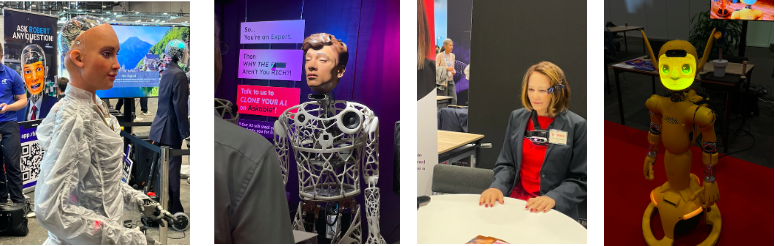
A highlight of the summit was the chance to witness firsthand the latest advancements in robotics, including Sophia the Robot, one of the most famous humanoid robots in the world. I also had the chance to meet robotics experts and see more innovative robots up close, including the Nadine Social Robot, Navel - the empathy robot, Robert: the AI robot revolutionizing financial education, Mirokaï, a robot by Enchanted Tools, and many more. This experience was a reminder of how far AI and robotics have come in terms of human–machine interaction.
The Broader Conversation
Beyond the robotic showcases, the summit fostered deep conversations about AI for social good and empathy design in the age of AI. Topics included:
Finally, a Presidential Address on AI Governance by H.E. Mr. Alar Karis, President of Estonia
Looking Ahead
AI has incredible potential to drive positive change, but it can also deepen existing divides if we’re not careful. For the MENA region, the future of AI and data must be inclusive, ethical, and locally informed.
Attending the AI for Good Summit left me inspired, but also challenged. AI is moving fast; we need to foster collaboration and build capacity for responsible data and AI practices. Our MENA Observatory on Responsible AI is a platform for a diversified regional network to share knowledge, exchange ideas, and advocate for impactful policies that ensure AI moves in the right direction. For AI to be good, it must reflect the people who shape it and define its impact.