Ethics as Strategy: What the MENA Observatory’s Responsible AI (RAI) Cup Taught Us About Building Zaher for the Long Run
2026-02-25

2026-02-25
 1915 Views
Written by: Zaher.AI
The Digital Attention Economy
"You become what you give your attention to." - Epictetus
Epictetus's quote takes on new weight today: in a world where most of our waking hours are online, what we consume eventually molds who we become. What was once deemed merely entertaining or informational has become an architect of identity, shaping how we think, what we value and our versions of the truth. The concept of the attention economy was first introduced in the late 1960s by Herbert A. Simon, an economics Nobel laureate who framed information overload as an economic problem, stating: "A wealth of information creates a poverty of attention." As the internet gained traction in the 1990s, strategists like Michael Goldhaber expanded the idea of the attention economy, arguing that "obtaining attention is obtaining a kind of enduring wealth - a form of wealth that secures a preferred position to access anything this new economy offers."
Every industry can be traced back to its ability to capture and monetize attention. The systematic engineering of time, identity, and behavior into economic value is what truly defines the attention economy. However, some industries have an existential relationship with attention. They don't just rely on it as fuel; they exist because of it. From a first-principles view, their entire value creation rests on mechanisms of capture and exploitation. Their strategies manipulate time extraction, scarcity, identity formation, and behavioral rewiring. One of the leading markets in this is the search industry.
We are living through a generational shift. AI search is growing at nearly 100% year-over-year, with a reported decline in traditional organic traffic causing a global loss of up to $21 billion. AI-generated overviews now occupy nearly half of screen space. Click-through rates are projected to drop by as much as 80% by 2026.
What used to be a ranking system has become a selection system.
AI engines do not rank pages.
They summarize.
They compress.
They decide.
And they do so inside largely opaque models, where only 2 out of 10 major foundation models score above 50% on transparency indicators, according to a study by Stanford, MIT, and Princeton.
For businesses, especially in emerging and Arabic-speaking markets, this creates a widening visibility gap. A projected $30 billion opportunity growing at double-digit CAGRs, but without the tools, analytics, or causal clarity to capture it.
Zaher was built in response to that shift.
Not as an SEO extension.
Not as a marketing tool.
But as an AI visibility co-pilot that is designed to give businesses clarity on how they are perceived inside AI systems, causality on what drives that perception, and the ability to actively shape it.
From day one, we understood something fundamental:
If AI is reshaping visibility, then responsibility must reshape architecture.
That conviction was tested and sharpened at the RAI Cup.
What is Zaher
At its core, Zaher is a visibility co-pilot for the AI-mediated search economy.
When someone asks ChatGPT, Gemini, or another AI engine about your industry, your competitors, or your category, Zaher helps you understand how and whether your brand appears in those answers.
We don’t optimize for rankings. We analyze perception.
Zaher runs structured query simulations across AI engines, scores how a brand is represented, measures sentiment and recognition depth, and tracks how that visibility changes over time. It breaks visibility down into components: recognition, sentiment, coherence, geographic alignment, and competitive positioning, instead of treating it as a black box outcome.
But visibility alone isn’t enough.
The system also provides recommendations and fixes customized to Zaher’s analysis and audit. If your brand is underrepresented in a category, we don’t just show the score; we show why and how to fix. Is it the content structure? Website performance? Language mismatch? Weak entity recognition? Inconsistent positioning across platforms?
This is where Zaher moves beyond traditional SEO tools.
Search engines rank pages. AI engines synthesize meaning.
So we built Zaher to analyze meaning.
And because we operate in Arabic-speaking markets, we made a deliberate decision early on: Zaher had to be Arabic-first, not translated into Arabic, but built with linguistic nuance, regional variation, and cultural identity as core variables. Modern Standard Arabic is not the same as Gulf Arabic. Levantine is not the same as Maghrebi. Visibility shifts across dialect and geography. Most global tools ignore that. We don’t.
Under the hood, Zaher combines multifactorial scoring models, simulation engines, explainable reporting layers, and a learning agent that refines recommendations over time. But the philosophy is simple:
Clarity over opacity.
Causality over correlation.
Customization over generic playbooks.
Zaher is among the first platforms in the region, and one of the early global movers, to focus entirely on Generative Engine Optimization (GEO). While most of the market is still thinking in terms of search rankings, we are working on how brands are interpreted, synthesized, and surfaced inside AI-generated answers. GEO is not merely an extension of SEO; it is a new discipline built for systems that summarize instead of list. From simulation-based query testing to multifactorial visibility scoring and Arabic-first benchmarking, Zaher was built specifically for this shift. We’re not adapting to the AI era; we are helping define how visibility works within it.
And that’s where Responsible AI stops being a compliance discussion and starts becoming a deliberate design decision for market leadership and discipline.
RAI Cup Journey
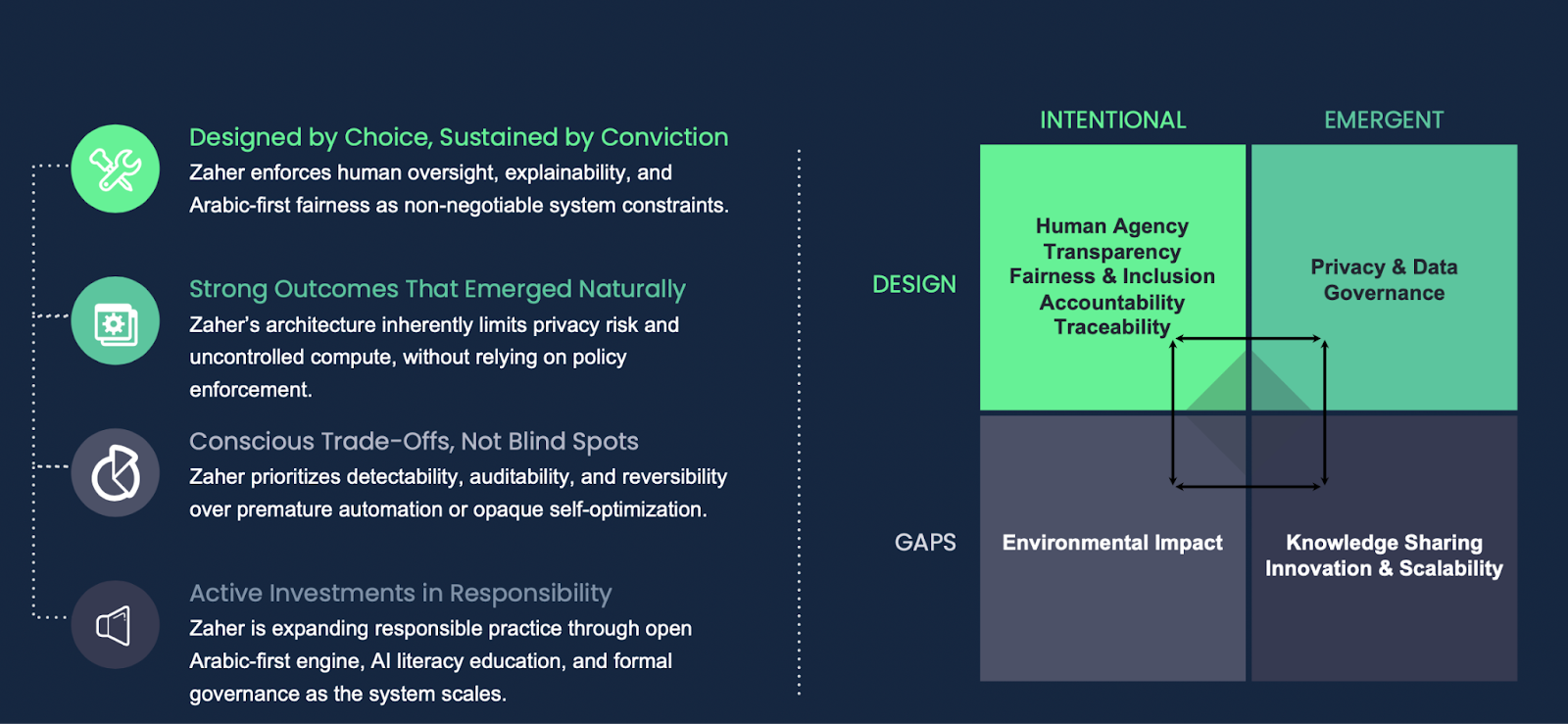
Before the RAI Cup, we believed Zaher was built responsibly. During the RAI Cup competition, we had to articulate why. And in doing so, we realized something important: some of our safeguards were intentional design decisions. Others had emerged naturally from how we engineered the system. And in a few areas, we had consciously chosen trade-offs instead of pretending perfection.
That distinction mattered. It helped us see Responsible AI not as a checklist, but as architecture.
From day one, Zaher’s outputs have been advisory. The system analyzes, simulates, and scores, but execution requires human approval. There is no autonomous publishing. No silent optimization. No self-directed changes to a client’s digital presence.
At the RAI Cup, we realized this wasn’t just product caution. It was governance by design.
Every score inside Zaher includes contextual reasoning. We separate confidence levels from raw visibility scores. If a brand is underrepresented in a category, we don’t just display a number; we surface the drivers behind it.
If we claim to solve opacity in AI systems, we cannot introduce new opacity ourselves.
Arabic is not a toggle in Zaher. It is structural.
Modern Standard Arabic behaves differently from Gulf, Levantine, or Maghrebi dialects. Visibility shifts across region, phrasing, and cultural context. Most global tools treat language as translation. We treat it as identity. Our fundamental understanding of semantic and sentiment analysis allows the model to build customizable recommendations far superior to merely translated ones.
RAI Cup sharpened this insight: ignoring linguistic variation isn’t just a feature gap, it’s systemic bias.
Every AI-driven outcome in Zaher has ownership. Logs are preserved. Simulations are reproducible. Results can be replayed over time. Auditability is not an enterprise add-on. It is trust infrastructure grounded in transparency and human supervision.
2. Strong Outcomes That Emerged Naturally
Interestingly, some of our strongest Responsible AI features were not originally framed as such. They emerged from Zaher’s engineering discipline.
Zaher operates within strict domain boundaries. We do not ingest personal identifiable information. Prompts are restricted in scope. Processing is ephemeral. Retention is minimal.
Originally, these decisions were made for efficiency and system clarity. During RAI Cup, we formalized them as Responsible AI controls. We realized something subtle: when architecture limits exposure by default, policy becomes reinforcement, not defense.
3. Conscious Trade-Offs, Not Blind Spots
Perhaps the most valuable part of the RAI Cup was identifying where we chose restraint. We deliberately prioritize detectability, auditability, and reversibility over premature automation.
In practice, that means:
We have postponed full ESG and carbon accounting until we reach statistical scale. Not because it is unimportant, but because premature metrics create false precision.
Responsible AI sometimes means acknowledging optimization limitations. That was an important internal clarification.
4. Active Investments in Responsibility
The RAI Cup also pushed us to think beyond internal controls. We realized that responsibility scales with influence. Zaher started investing in:
Education, transparency, and benchmarking are not marketing strategies for us. They are risk mitigation mechanisms. The more critical it becomes to have AI visibility, the more disciplined its builders must be.
What Changed for Us
We’ve always believed that AI would reshape visibility. But the RAI Cup forced us to confront a harder question: if AI systems increasingly influence who gets surfaced, recommended, or omitted, what responsibility do the builders of those systems carry?
It became clear that Responsible AI, for us, could not live in a policy document. It could not be a compliance checklist. And it certainly could not be a marketing badge.
It had to live inside the architecture.
That means some features move slower than they technically could. It means automation is constrained by human review. It means explainability sometimes takes precedence over performance shortcuts. It means fairness is treated as a structural variable, not an afterthought.
In other words, we stopped thinking of responsibility as something we apply to Zaher. We began thinking of it as something Zaher has built around.
Because visibility is power.
When AI systems summarize reality, they influence markets. They influence credibility. They influence opportunity. And if those systems are opaque, untraceable, or culturally blind, the imbalance compounds.
So for us, Responsible AI is not a defensive posture. It is a strategic infrastructure.
In a world where AI increasingly decides who gets seen and who doesn’t, the architecture behind that visibility matters more than ever.
And that realization will continue shaping how we build. Responsibly.